Category: Employee Benefits

  • Custom Content Article

    At eTekhnos, we post for clients weekly to ensure traffic on their Social Media sites. Here is an example of our latest custom piece about Holiday Parties that our content writer on staff recently wrote and published for our clients.

    The Perks of Holiday Parties: How They’re Still an Asset to Your Company

    The end of the year is upon us and a majority of companies celebrate with an end-of-year/holiday party. Although the trend of holiday parties has diminished in recent years, it’s still a good idea to commemorate the year with an office perk like a fun, festive party.

    BENEFITS OF A YEAR-END CELEBRATION

    • Holiday staff parties are a perfect way to thank your employees for a great year. All employees want to feel appreciated and valued. What better way to serve this purpose, than with an end of the year office celebration. Hosting a night out to honor your employees during a festive time of year boosts morale. And if done right, your party can jump start the new year with refreshed, productive employees.
    • End-of-year celebrations allow employees to come together outside of their own team. The average American will spend 90,000 hours (45 years) of their life at work. Unless you have a very small office, most employees only engage in relationships within their department. When employees have a chance to mingle outside of their regular 9 to 5 day, they’ll build and cultivate relationships across different teams within the organization; creating a more loyal, cohesive and motivated culture.
    • Seasonal parties can provide employers insight on those who work for them. Spending the evening with your employees in a more casual and relaxed atmosphere may reveal talents and ideas you may not have otherwise seen during traditional work hours.

    CREATING THE RIGHT FIT

    Regardless of office size, if planned right, employers can make a holiday party pop, no matter your budget. Whether this is your first go at an end-of-year celebration for your employees, or you host one every year, keep a few things in mind:

    • Plan early. Establish a steering committee to generate ideas for your holiday party. Allow the committee to involve all employees early on in the process. Utilize voting tools like Survey Monkey or Outlook to compile employee votes. This engages not only your entire workforce, but serves you as well when tailoring your party to fit your culture.
    • Create set activities. Engaging employees in some type of organized activity not only eases any social anxiety for them and their guests, it cultivates memories and allows colleagues to get to know each other. Consider a “Casino Night”, a photo booth (or two if your company can justify to size), an escape room outing—anything that will kick the night off with ease.
    • Incorporate entertainment during the dinner. Have team leads or management members come up with fun awards that emphasize character traits, strengths, and talents others may not know of. This is a great way to create cohesiveness, build relationships, and have your employees enjoy a good laugh at dinner.
    • Offer fun door prizes every 15 minutes or so. Prizes don’t have to be expensive to have an impact on employees, just relevant to them. However, with the right planning you may be able to throw in a raffle of larger gift items as well. Just keep in the specific tax rules when it relates to gift-giving. Gift cards associated with a specific dollar amount available to use at any establishment, and larger ticket items, can be subject to your employees having to claim income on them and pay the tax.
    • Make the dress code inclusive of everyone. Employees should not feel a financial pinch to attend a holiday office party. Establish a dress code that fits your culture, not the other way around.

    TAKE AWAY TIPS FOR A SUCCESSFUL HOLIDAY PARTY

    According to the Society of Human Resource Management, statistics show in recent years only 65% of employers have offered holiday parties—down from 72% five years ago. Consider the following tips when hosting your next year-end celebration.

    • Keep it light. Eliminate itineraries and board-room like structure. Choose to separate productivity/award celebrations and upcoming year projections from your holiday party.
    • Invite spouses and significant others to attend the party. Employees spend a majority of their week with their colleagues. Giving employees this option is a great way to show you value who they spend their time with outside of work.
    • Allow employees to leave early on a work day to give them time to get ready and pick up who is attending the party with them.
    • Show how you value your employees by chatting with them and meeting their guests.
    • Provide comfortable seating areas where employees can rest, eat and talk. Position these in main action areas so no one feels anti-social for taking a seat somewhere.
    • Consider tying in employees that work in different locations. Have a slideshow running throughout the night on what events other office locations have done throughout the year.
    • Create low-key conversation starters and get people to chat it up. This is valuable especially for those that are new to the company and guests of your employees. Incorporate trivia questions into the décor and table settings. Get them to engage by tying in a prize.
    • Keep the tastes and comfort level of your employees in mind. Include a variety of menu items that fit dietary restrictions. Not all employees drink alcohol and not all employees eat meat.
    • Limit alcohol to a 2 ticket system per guest. Opt for a cash bar after that to reduce liability.
    • Provide access to accommodations or coordinate transportation like Uber or Lyft to get your employees somewhere safely after the party if they choose to drink.

    Ultimately, holiday parties can still be a value-add for your employees if done the right way. Feel free to change it up from year to year so these parties don’t get stale and continue to fit to your company’s culture. Contemplate new venues, ideas and activities and change up your steering committee to keep these parties fresh. Employees are more likely to enjoy themselves at an event that fits with their lifestyle, so don’t be afraid to get creative!

    Contact us about our custom content and article postings!


  • How to Develop a Killer Content Marketing Strategy for Benefit Agencies

    Why You Need Content Marketing

    As social media marketing becomes more popular with companies whose clientele consists of other businesses, it’s important to understand how a quality content strategy can enhance your online brand. Creative content serves your business in two important ways.

    First, content crafted to tell your company’s story in an interesting, innovative way helps your audience connect with your brand and better understand your product. This is vital for turning social media interactions into leads and customer action.

    Second, the more relevant and valuable content you produce and publish, the higher you will be ranked in search engine result lists. If a potential client is Googling “2016 ACA compliance,” and you’ve published a recent blog on deadlines and reporting, your content will show up in search results, prompting the searcher to click through to your website. The more unique and niche content you produce on a topic, the more likely you are to show up high in Google results, and the more prospects you will drive to your website.

    In the age of technology, the average person is bombarded with thousands of advertisements a day. Because of this, it is essential that companies are intentional and innovative with their content marketing. We’ve put together a list of some of the best ways to ensure you develop an effective strategy for your company.

    The Content

    In a study conducted by the Content Marketing Institute, creating engaging content ranked as a top priority at 72% for developing new material to post on your blog and social media. In the benefits industry, it is essential that you clearly convey how your company stands apart from other firms as the best option for crafting unique benefit packages, streamlining compliance and developing HR solutions. Focus on choosing relevant industry topics to present in an innovative way. To optimize your creative approach, try implementing the following best practices:

    Visuals

    Use pictures, infographics, and charts to inform your clients about your process and services visually. These mediums effectively grab clients’ attention and can help you convey information in a simple yet informative manner.

    Long-Form Content

    Be more analytic with lengthy and complex written content. Make sure to research thoroughly and back up your key points with real facts. Not only does long-form content give you room to explain fully to clients what needs your benefit agency meets, but also sets you up as a go-to industry source.

    Specialized Experts

    The benefit industry has a very specific target market, so to consistently create cutting edge content, an industry expert is an essential part of your marketing team. According to Curata, in 2017, 51% of companies will have an executive whose role is solely devoted to content marketing. Your company should employ or contract an industry expert (like eTekhnos!) to produce content and advise on how to best reach your preferred customers. Expert-informed content boosts your brand’s credibility and ensures that clients have somewhere reliable to turn to when they need help with difficult or complex benefit questions.

    Stay Up-To-Date and Be One Step Ahead

    As you create your own company-specific content calendar, it is equally important to stay up-to-date on what your competitors are talking about on their blogs and social media. Reading blogs, posts and articles that discuss how to create optimal content can help foster new ideas and also reveal what’s trending in employee benefits and human resources. Content marketing is always changing and evolving at a fast pace, and staying current on best practices and hot topics gives you a crucial advantage.

    Implement these best practices, and contact us today for help developing a custom content marketing strategy!


    By Nicole Federico and Kate McGaughey

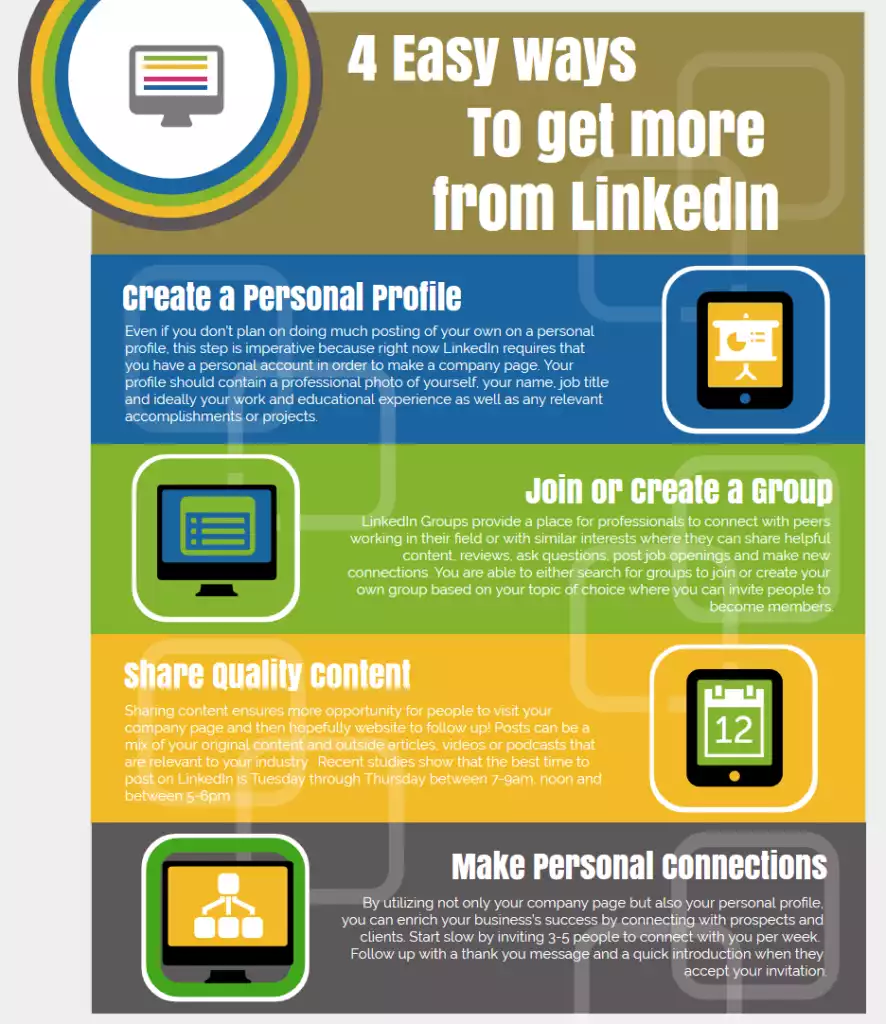
  • 4 Easy Ways to Get More Out of LinkedIn | Employee Benefits Technology

    As employee benefit agencies, we know it can be hard to figure out the best way to leverage social media for your company, so we’ve made it easy.  Follow these four steps to get more out of LinkedIn today!

    LinkedIn infographic


    Want to learn more? Go in depth with our post 5 Ways to Optimize LinkedIn for Your Benefit Agency.

  • How to Write an Engaging About Page for Your Website

    F7OLW2SG0CDoes your About page grab potential clients’ attention or does it leave them yawning? We’re sharing tips on tone, content and format for creating an engaging About page that will make people want to work with your agency today!

    Tone

    When a potential client reads your About page they should feel like they are meeting you face-to-face for the first time.  You have the chance to make a good impression by adopting a conversational and human tone while still communicating what makes your services unique and superior.  An easy way to do this is embrace the use of “I” and “we” rather than writing from a formal, third person perspective. Your tone should be authentic and relatable while remaining professional.

    Content

    What should you talk about? Focus on telling your story with simplicity rather than filling an About page with industry jargon or fluffy descriptions.  People want to know where you came from, what you can do for them and why you are a credible choice. Show that you understand your potential client’s challenges and use examples of things you’ve done in the past to let them know you can solve their problems.

    Finally, always include a call to action.  What do you want them to do next? Your goal with your About page should be to motivate potential clients to contact you about your services.  Place contact information visibly on the page. Include several ways to get in touch including a contact form, email, phone number and physical address.

    Format

    Your About page offers a glimpse into who you are as a company – your history, the principles by which you do business and the people who make up your team. It is your first chance to establish trust with a client by showing who the people behind the brand are.  Don’t be afraid to move away from the traditional corporate About page format and get a little creative with what makes your company unique. Include images of your team that put a face to the name.  We like what Brio Benefits has done to showcase their team by incorporating a corporate portrait and a funny, personable candid photo along with each employee bio.  To view their About page, click here.

    Think your About page needs a revamp?  Contact us today and we’ll get you started!

  • 5 Ways to Optimize LinkedIn for Your Benefit Agency

    9011116378_32e56983e3_c
    Photo by Sebastiaan ter Burg

    LinkedIn is fast proving to be the foremost social media site for B2B marketing. Employee benefit agencies that rely on cultivating relationships in order to market a product or service may find utilizing more fast-moving social platforms like Twitter or Instagram challenging, but LinkedIn provides a space for professionals to interact with one another, share original industry content and create brand awareness for their company that results in leads and network growth. We’ve put together a list of five simple ways you can start optimizing LinkedIn for your business today:

    1. Create a Personal Profile

    Even if you don’t plan on doing much posting of your own on a personal profile, this step is imperative because right now LinkedIn requires that you have a personal account in order to make a company page. Your profile should contain a professional photo of yourself, your name, job title and ideally your work and educational experience as well as any relevant accomplishments or projects.

    1. Set Up a Company Page

    Now that you’ve created your personal page, you are able to set up a page that specifically provides information about your company to LinkedIn users.  This page should contain your company name, logo, a link to your website, and a short description of your business that includes relevant keywords that are specific to what you do. Keywords can be in the form of phrases such as “Maryland insurance broker” but should shy away from staying as vague as “insurance company.” This helps your page receive a higher ranking in search engine results. Finally, ask employees who have personal LinkedIn profiles to list your company in their work experience, helping ensure that you can be found easily when people search for your business.

    1. Share Quality Content

    Sharing content ensures more opportunity for people to visit your company page and then hopefully website to follow up! Posts can be a mix of your original content and outside articles, videos or podcasts that are relevant to your industry.  Recent studies show that the best time to post on LinkedIn is Tuesday through Thursday between 7-9am, noon and between 5-6pm.  In addition, data revealed that posts made on Tuesday between 10-11am have the most clicks and shares. For best engagement results, companies should make it a priority to post on their LinkedIn page once a week, but no more than once a day.

    1. Join or Create a Group

    LinkedIn Groups provide a place for professionals to connect with peers working in their field or with similar interests where they can share helpful content, reviews, ask questions, post job openings and make new connections. You are able to either search for groups to join or create your own group based on your topic of choice where you can invite people to become members.  These groups are useful for connecting with prospects and establishing your company as an industry expert.

    1. Make Personal Connections

    By utilizing not only your company page but also your personal profile, you can enrich your business’s success by connecting with prospects and clients. Start slow by inviting 3-5 people to connect with you per week.  Follow up with a thank you message and a quick introduction when they accept your invitation.  Did you write a blog for your company or on an industry topic?  Post it to you profile. As you continue to share content, consider submitting it to LinkedIn Pulse’s editors to have your blog post featured.  This translates to much more visibility for your company! Finally, don’t be afraid to engage with others.  If you see content you like, write a comment or send a quick message to the author.  Other LinkedIn members are interested in the same thing you are – building mutually beneficial relationships!

    Generating brand awareness for your company on social media is becoming more and more important in our highly digitalized economy. LinkedIn offers the perfect space for your company using a B2B marketing model that is based largely on relationships to thrive and establish yourself as an industry expert while expanding your network of prospects and future business connections.

  • 3 Ways Social Media Helps Employee Benefits Firms

    MH46O0ISCFIn the world of employee benefits, we know that relationships are key. Particularly for independent firms, a new client is more likely to be obtained through a game of golf with a current client who knows local business owners than by a YouTube video explaining an online enrollment process. However, companies that do this type of B2B marketing can highly benefit from a robust social media presence, and we’re here to tell you how with three simple points:

    1. Increase Relational Reach

    Most professionals today have accounts on LinkedIn if not Facebook and Twitter. These three big social media channels offer a unique opportunity to nurture current business relationships and foster new ones. Becoming a part of industry groups on social media helps your business see who else is in your field with whom you could build partnerships or share services and keep up with what your current clients are doing both in business and in the community.  With private messaging, industry groups and platforms for public sharing, it’s easy to make initial and continuing points of contact with both current and prospective clients.  Don’t stop at just a business page – drive engagement by posting, sharing and connecting through your personal account and encourage your employees to do so as well – this adds an extra relational aspect to your brand which shows you personally care about your clients.

    1. Become Industry Experts

    One of the biggest things social media can do for your brand is add credibility as an industry expert through the content you post, thus giving you more opportunity to develop relationships with a larger pool of people. Start by creating a blog post a few times a month that educates about a unique service you offer or explains an aspect of employee benefits that is often confusing to clients. The key is to offer content that is engaging, educational and gives value to the reader – this should not be a sales pitch – quality content will bring a reader back for more. Share this post on your company and personal LinkedIn, Facebook and Twitter accounts and encourage employees to do the same. Reply to comments and shares with a personal note of thanks or a follow up question to foster engagement!

    1. Offer Creative Content

    We know it’s important to create original content, but what does that look like? Start with a blog. Write succinct posts about topics relevant to your industry, but don’t be afraid to think outside the box a little bit.  We all know employee benefits topics can get boring, but what about doing a profile on an employee who has benefited from a client’s wellness program that your firm set up?  People want to hear her story. As you get more comfortable, explore other mediums.  Share photos from company workshops or community events where you were participants or make a short video explaining a commonly misunderstood aspect of employee benefits packages. And don’t worry – if you don’t know where to start with creating content, there are companies to which you can outsource that will help you find the perfect way to share your story as an employee benefits broker.

    Social media is increasingly becoming a vital tool in how we do business in today’s economy.  By understanding and implementing these three concepts about how to use social media in the employee benefits field, you can expand your relational reach, establish your business as an industry expert and offer diverse creative content that sets your brand apart and generates client loyalty.

  • Everyone Benefits from an Employee Portal

    Not so long ago, it was only large corporations that could even consider setting up self-service portals for their employees. But now, thanks to the outsourcing model, companies with only a handful of workers are taking full advantage of employee portal technology.

    They’re saving everyone involved – employees, the HR department, management – significant time, money, and effort.

    Perhaps best of all, by reducing paperwork and speeding access to important information, such employee portals are helping companies to boost employee satisfaction and loyalty – and, in turn, productivity. Here’s how:

    LESS WORK

    Think of the employee portal as your HR department embracing the power of e-commerce. That means eliminating the tedious filling out and shuffling of paper forms and having to decipher employees’ scrawl. And it means no re-keying of data into a computer. In addition, most follow-up phone calls are done away with, as well.

    Instead, workers can visit their company’s employee portal via any web-equipped computer or hand-held device and gain direct – and entirely secure – access to a wide range of useful work-related information all on their own, with practically no need for anyone in HR to get involved.

    INSTANT ACCESS

    Employees can view insurance benefits, 401(k) plans, company policies, you name it, all with just a few clicks of their mouse. And they can browse or print out any number of important documents, such as the employee handbook. Likewise, should their employer decide to make it possible – and many do – employees may enter and update their HR-related data all on their own. They can change their withholding status, enroll for new benefits, or update time and attendance records.

    Naturally, all of this employee portal activity is controlled with the latest in security techniques. Each employee can be assigned his or her own, unique log-in ID and password for authorizing entry to the portal. In addition, the HR department can specify exactly which data and documents are to be made available to each particular employee.

    MORE PRODUCTIVITY

    Clearly, this kind of employee portal pleases its users. They no longer have to waste time filling out form after form or waiting on hold when calling HR for, say, an explanation of their medical plan. Moreover, the people in HR are freed to devote their time and energy to productive tasks, as well. It’s win-win for everyone.

  • Everyone Benefits from an Employee Portal

    Not so long ago, it was only large corporations that could even consider setting up self-service portals for their employees. But now, thanks to the outsourcing model, companies with only a handful of workers are taking full advantage of employee portal technology.

    They’re saving everyone involved – employees, the HR department, management – significant time, money, and effort.

    Perhaps best of all, by reducing paperwork and speeding access to important information, such employee portals are helping companies to boost employee satisfaction and loyalty – and, in turn, productivity. Here’s how:

    LESS WORK

    Think of the employee portal as your HR department embracing the power of e-commerce. That means eliminating the tedious filling out and shuffling of paper forms and having to decipher employees’ scrawl. And it means no re-keying of data into a computer. In addition, most follow-up phone calls are done away with, as well.

    Instead, workers can visit their company’s employee portal via any web-equipped computer or hand-held device and gain direct – and entirely secure – access to a wide range of useful work-related information all on their own, with practically no need for anyone in HR to get involved.

    INSTANT ACCESS

    Employees can view insurance benefits, 401(k) plans, company policies, you name it, all with just a few clicks of their mouse. And they can browse or print out any number of important documents, such as the employee handbook. Likewise, should their employer decide to make it possible – and many do – employees may enter and update their HR-related data all on their own. They can change their withholding status, enroll for new benefits, or update time and attendance records.

    Naturally, all of this employee portal activity is controlled with the latest in security techniques. Each employee can be assigned his or her own, unique log-in ID and password for authorizing entry to the portal. In addition, the HR department can specify exactly which data and documents are to be made available to each particular employee.

    MORE PRODUCTIVITY

    Clearly, this kind of employee portal pleases its users. They no longer have to waste time filling out form after form or waiting on hold when calling HR for, say, an explanation of their medical plan. Moreover, the people in HR are freed to devote their time and energy to productive tasks, as well. It’s win-win for everyone.

  • Why your Business needs an Intranet

    These days, most corporations have their own intranet, which is somewhat like the internet except for the fact that it’s only accessible to those within the company. However, Intranets are not just useful for large enterprises, SMEs can benefit from them hugely too.

    An intranet means that internal communications within a company are simplified substantially and make for more success in terms of growth, as productivity increases. It’s basically an internal database which every employee can access, with different permissions for various staff.

    For example, it’s doubtful that you want junior office staff to be able to access all of your financial reports and forecasts for the year, so these are just given permissions to access certain areas of the intranet which is relevant to their job.

    According to Microsoft: “In order for a company to succeed, all players must understand its goals. Neither long-term nor short-term goals should be confined to upper management meetings. It’s Business 101. Everyone needs to be working toward common goals”.

    By building an intranet, employees and bosses alike can share information across the board; not only is it easier to set up and share appointments and information, but as a part of an intranet, employees can communicate better, leading to less confusion following meetings, when everyone has to take notes and remember everything afterwards.

    Not only that but intranets have evolved dramatically over the past decade as CMS and social are added and the introduction of cloud computing often means that an intranet can be accessed from anywhere. This is ideal in these days of BYOD and telecommuting, as it makes for a more flexible workforce and again, ups productivity

    That’s even before we go into the benefits presented by ROI, which can be substantial, depending on what model you use and the size of your business.

    Developing an Intranet

    It’s a good idea to carry out sound planning before implementing an Intranet; whilst they can and will benefit a business of any size, needs vary and so it’s worth investing primarily in a decent consultancy firm. These will be able to carry out an audit of your company and recommend what will benefit your business the most.

    A modern intranet should be well organized and easy for users to navigate, especially if you don’t want to spend a fortune training your staff; again, this is something that can be discussed with a consultant.

    A well planned business infrastructure is much more likely to be a successful one and one that your company can see clear benefits from. The ability to share internal information across the whole of your staff often does away with the need to constantly send internal memos and emails.

    Discussion boards on an intranet can also help staff to come up with collaborative ideas before meetings or when working on a project, cutting down the time needed for physical meetings as everyone is aware of their position on a project.

    Read More (Source: Kerry, elcomcms.com)

  • Everyone Benefits from an Employee Portal

    Not so long ago, it was only large corporations that could even consider setting up self-service portals for their employees. But now, thanks to the outsourcing model, companies with only a handful of workers are taking full advantage of employee portal technology.

    They’re saving everyone involved – employees, the HR department, management – significant time, money, and effort.

    Perhaps best of all, by reducing paperwork and speeding access to important information, such employee portals are helping companies to boost employee satisfaction and loyalty – and, in turn, productivity. Here’s how:

    LESS WORK

    Think of the employee portal as your HR department embracing the power of e-commerce. That means eliminating the tedious filling out and shuffling of paper forms and having to decipher employees’ scrawl. And it means no re-keying of data into a computer. In addition, most follow-up phone calls are done away with, as well.

    Instead, workers can visit their company’s employee portal via any web-equipped computer or hand-held device and gain direct – and entirely secure – access to a wide range of useful work-related information all on their own, with practically no need for anyone in HR to get involved.

    INSTANT ACCESS

    Employees can view insurance benefits, 401(k) plans, company policies, you name it, all with just a few clicks of their mouse. And they can browse or print out any number of important documents, such as the employee handbook. Likewise, should their employer decide to make it possible – and many do – employees may enter and update their HR-related data all on their own. They can change their withholding status, enroll for new benefits, or update time and attendance records.

    Naturally, all of this employee portal activity is controlled with the latest in security techniques. Each employee can be assigned his or her own, unique log-in ID and password for authorizing entry to the portal. In addition, the HR department can specify exactly which data and documents are to be made available to each particular employee.

    MORE PRODUCTIVITY

    Clearly, this kind of employee portal pleases its users. They no longer have to waste time filling out form after form or waiting on hold when calling HR for, say, an explanation of their medical plan. Moreover, the people in HR are freed to devote their time and energy to productive tasks, as well. It’s win-win for everyone.