Category: Blogging

  • Custom Content Article

    At eTekhnos, we post for clients weekly to ensure traffic on their Social Media sites. Here is an example of our latest custom piece about Holiday Parties that our content writer on staff recently wrote and published for our clients.

    The Perks of Holiday Parties: How They’re Still an Asset to Your Company

    The end of the year is upon us and a majority of companies celebrate with an end-of-year/holiday party. Although the trend of holiday parties has diminished in recent years, it’s still a good idea to commemorate the year with an office perk like a fun, festive party.

    BENEFITS OF A YEAR-END CELEBRATION

    • Holiday staff parties are a perfect way to thank your employees for a great year. All employees want to feel appreciated and valued. What better way to serve this purpose, than with an end of the year office celebration. Hosting a night out to honor your employees during a festive time of year boosts morale. And if done right, your party can jump start the new year with refreshed, productive employees.
    • End-of-year celebrations allow employees to come together outside of their own team. The average American will spend 90,000 hours (45 years) of their life at work. Unless you have a very small office, most employees only engage in relationships within their department. When employees have a chance to mingle outside of their regular 9 to 5 day, they’ll build and cultivate relationships across different teams within the organization; creating a more loyal, cohesive and motivated culture.
    • Seasonal parties can provide employers insight on those who work for them. Spending the evening with your employees in a more casual and relaxed atmosphere may reveal talents and ideas you may not have otherwise seen during traditional work hours.

    CREATING THE RIGHT FIT

    Regardless of office size, if planned right, employers can make a holiday party pop, no matter your budget. Whether this is your first go at an end-of-year celebration for your employees, or you host one every year, keep a few things in mind:

    • Plan early. Establish a steering committee to generate ideas for your holiday party. Allow the committee to involve all employees early on in the process. Utilize voting tools like Survey Monkey or Outlook to compile employee votes. This engages not only your entire workforce, but serves you as well when tailoring your party to fit your culture.
    • Create set activities. Engaging employees in some type of organized activity not only eases any social anxiety for them and their guests, it cultivates memories and allows colleagues to get to know each other. Consider a “Casino Night”, a photo booth (or two if your company can justify to size), an escape room outing—anything that will kick the night off with ease.
    • Incorporate entertainment during the dinner. Have team leads or management members come up with fun awards that emphasize character traits, strengths, and talents others may not know of. This is a great way to create cohesiveness, build relationships, and have your employees enjoy a good laugh at dinner.
    • Offer fun door prizes every 15 minutes or so. Prizes don’t have to be expensive to have an impact on employees, just relevant to them. However, with the right planning you may be able to throw in a raffle of larger gift items as well. Just keep in the specific tax rules when it relates to gift-giving. Gift cards associated with a specific dollar amount available to use at any establishment, and larger ticket items, can be subject to your employees having to claim income on them and pay the tax.
    • Make the dress code inclusive of everyone. Employees should not feel a financial pinch to attend a holiday office party. Establish a dress code that fits your culture, not the other way around.

    TAKE AWAY TIPS FOR A SUCCESSFUL HOLIDAY PARTY

    According to the Society of Human Resource Management, statistics show in recent years only 65% of employers have offered holiday parties—down from 72% five years ago. Consider the following tips when hosting your next year-end celebration.

    • Keep it light. Eliminate itineraries and board-room like structure. Choose to separate productivity/award celebrations and upcoming year projections from your holiday party.
    • Invite spouses and significant others to attend the party. Employees spend a majority of their week with their colleagues. Giving employees this option is a great way to show you value who they spend their time with outside of work.
    • Allow employees to leave early on a work day to give them time to get ready and pick up who is attending the party with them.
    • Show how you value your employees by chatting with them and meeting their guests.
    • Provide comfortable seating areas where employees can rest, eat and talk. Position these in main action areas so no one feels anti-social for taking a seat somewhere.
    • Consider tying in employees that work in different locations. Have a slideshow running throughout the night on what events other office locations have done throughout the year.
    • Create low-key conversation starters and get people to chat it up. This is valuable especially for those that are new to the company and guests of your employees. Incorporate trivia questions into the décor and table settings. Get them to engage by tying in a prize.
    • Keep the tastes and comfort level of your employees in mind. Include a variety of menu items that fit dietary restrictions. Not all employees drink alcohol and not all employees eat meat.
    • Limit alcohol to a 2 ticket system per guest. Opt for a cash bar after that to reduce liability.
    • Provide access to accommodations or coordinate transportation like Uber or Lyft to get your employees somewhere safely after the party if they choose to drink.

    Ultimately, holiday parties can still be a value-add for your employees if done the right way. Feel free to change it up from year to year so these parties don’t get stale and continue to fit to your company’s culture. Contemplate new venues, ideas and activities and change up your steering committee to keep these parties fresh. Employees are more likely to enjoy themselves at an event that fits with their lifestyle, so don’t be afraid to get creative!

    Contact us about our custom content and article postings!



  • Custom Content for Benefit Agencies | How Paid Parental Leave is Changing the Benefits Landscape

    There’s no doubt that original content boosts your search engine rankings, establishes credibility as an industry expert, and generates interest in your services. Yet many benefit agencies struggle to produce timely, quality content simply because they don’t have the bandwidth to get it done. At eTekhnos we offer customized social media marketing plans to fit your agency. Along with curated relevant content on compliance issues and top HR and benefit trends, we prioritize creating custom pieces on the latest hot topics! Here’s a sample blog article we recently produced for our clients on the rising 2017 benefit trend of paid parental leave:

    How Paid Parental Leave is Changing the Benefits Landscape

    When you hear the term “paid parental leave”, what do you think of? Here in the U.S., paid leave benefits are somewhat of a luxury. Although the Family and Medical Leave Act (FMLA) has made it possible for parents working at companies with 50 or more employees to secure 12 weeks of unpaid leave, the U.S. is one of only three countries on a list of 185 that does not mandate a period of paid parental leave. This leaves the country ranked below Iran and Mexico, who both offer 12 weeks of paid parental leave. On the other end of the spectrum, employees in the UK benefit from up to 40 weeks of paid leave.

    As a result of having no mandated paid parental leave policy, approximately a quarter of U.S. women who become pregnant while employed quit their jobs upon giving birth, one third of women are forced to borrow money or withdraw from savings to cover time off from work, and 15% utilize public assistance. The June 2015 Enforcement Guidance on Pregnancy Discrimination from the Equal Employment Opportunity Commission (EEOC) was the first legislation to make a case for offering equal parental leave to mothers and fathers, setting a new precedent for the evolution of the paid leave benefit.

    Why Should You Offer Paid Parental Leave to Employees?

    The EY & Peterson Institute for International Economics recently released a study revealing that 38% of millennials would move to a new country if they would be afforded better paid parental leave benefits. Millennials now make up the largest demographic in the American workforce, and companies will need to increasingly take statistics like this into account when building benefit plans that will attract and retain top talent.

    Aside from talent acquisition, the study goes on to show the positive impacts a paid parental leave benefit can have on keeping women in the C-Suite, as men who would usually be considered secondary caregivers take advantage of the time off and allow women to get back to work more quickly. In addition, change.org, who has implemented a generous paid parental leave policy, observed that dads who took leave in their company encouraged other new fathers to take advantage of the benefits as well, creating a culture of safety in which to utilize leave and invest more fully in their family life.

    Ultimately, employees are happier and are empowered to do better work when they are allowed to honor their priorities. Whether this means a new mother is allowed to take stress-free, paid time off to bond with her child, or a father takes advantage of leave to be with his family or allow his partner to return to work, the ability to balance work and life is of the utmost importance to younger generations.

    Case Studies – Top Companies Doing it Right

    American Express

    American Express recently announced that they were changing their paid parental leave policy from three months for primary caregivers and two weeks for secondary caregivers to five months of paid parental leave for all full-time and part-time employees.

    All genders are eligible for the benefit, and employees may become parents via birth, adoption or surrogacy. In addition, American Express offers up to $35,000 for adoption or surrogacy fees with a limit of two events.  A lifetime maximum of $35,000 is also allotted for fertility treatments.

    The company also announced a unique supplemental benefit of 24-hour lactation consultants available to nursing mothers, and a breast milk shipment program available to mothers traveling for business who need to send milk home.

    Bank of America

    Bank of America offers 16 weeks of paid leave for biological and adoptive parents. A unique feature of their policy allows parents to take leave any time during the first year of the child’s life, enabling partners to take overlapping or subsequent time off, whichever best fits their family’s needs. The company values providing this option, as they see almost half of parents in today’s society raising their kids together at home while both holding jobs.

    The banking giant also tries to make life after baby easier for working parents by offering a more flexible work-from-home program and providing $240 in monthly childcare reimbursement for employees whose household income comes in under $100,000 annually.

    Netflix

    Netflix took the spotlight when it comes to paid parental leave benefits when they announced that the company would offer unlimited paid leave with no loss of benefits during the first year after a child’s arrival. Leave can be taken at any time during the year, and employees may choose to work part-time, or come back to work and then leave again if desired.

    Netflix chief talent officer, Tawni Cranz, said of the monumental decision, “Experience shows people perform better at work when they’re not worrying about home.”

    Twitter

    While Twitter offers 20 weeks of paid leave for mothers and 10 for fathers and adoptive parents, the most innovative benefits this company offers come through its pre and post-natal programs for parents. Twitter offers quarterly “New Moms and Moms-To-Be” roundtables, a Mommy Mentor Program, Working Mom lunches and most lately, “Dads on Leave” roundtables. In-house support for employees when it comes to family life provides a safe place to embrace new roles as parents while still progressing in their careers.

    How Can You Adopt This Benefit?

    Job participation by women in peak years is declining, and paid parental leave is a way to help remove barriers in the workplace that leave women in only 5% of CEO positions at Fortune 500 companies. Karyn Twaronite, EY global diversity and inclusiveness officer, said, “Companies that view parental leave as something solely for mothers are becoming extinct, as more modern and enlightened companies are realizing that many people, especially millennials, are even more interested in co-parenting given most are part of dual career couples.”

    If your company is unable to keep up with the generous paid leave packages larger businesses can afford, consider taking a page out of Twitter’s book and offering mentoring programs and support groups for new parents. Budget for childcare reimbursement costs like Bank of America. Even smaller changes that are made thoughtfully, with the employee in mind, will increase the appeal of your benefits package.

    As the benefits landscape changes with shifting demographics, consider carefully how offering paid parental leave could positively impact your employees, and ultimately, your bottom line as workers are motivated to work harder and smarter, knowing things are taken care of at home.


    By Kate McGaugheySocial Media Director, eTekhnos

  • How to Develop a Killer Content Marketing Strategy for Benefit Agencies

    Why You Need Content Marketing

    As social media marketing becomes more popular with companies whose clientele consists of other businesses, it’s important to understand how a quality content strategy can enhance your online brand. Creative content serves your business in two important ways.

    First, content crafted to tell your company’s story in an interesting, innovative way helps your audience connect with your brand and better understand your product. This is vital for turning social media interactions into leads and customer action.

    Second, the more relevant and valuable content you produce and publish, the higher you will be ranked in search engine result lists. If a potential client is Googling “2016 ACA compliance,” and you’ve published a recent blog on deadlines and reporting, your content will show up in search results, prompting the searcher to click through to your website. The more unique and niche content you produce on a topic, the more likely you are to show up high in Google results, and the more prospects you will drive to your website.

    In the age of technology, the average person is bombarded with thousands of advertisements a day. Because of this, it is essential that companies are intentional and innovative with their content marketing. We’ve put together a list of some of the best ways to ensure you develop an effective strategy for your company.

    The Content

    In a study conducted by the Content Marketing Institute, creating engaging content ranked as a top priority at 72% for developing new material to post on your blog and social media. In the benefits industry, it is essential that you clearly convey how your company stands apart from other firms as the best option for crafting unique benefit packages, streamlining compliance and developing HR solutions. Focus on choosing relevant industry topics to present in an innovative way. To optimize your creative approach, try implementing the following best practices:

    Visuals

    Use pictures, infographics, and charts to inform your clients about your process and services visually. These mediums effectively grab clients’ attention and can help you convey information in a simple yet informative manner.

    Long-Form Content

    Be more analytic with lengthy and complex written content. Make sure to research thoroughly and back up your key points with real facts. Not only does long-form content give you room to explain fully to clients what needs your benefit agency meets, but also sets you up as a go-to industry source.

    Specialized Experts

    The benefit industry has a very specific target market, so to consistently create cutting edge content, an industry expert is an essential part of your marketing team. According to Curata, in 2017, 51% of companies will have an executive whose role is solely devoted to content marketing. Your company should employ or contract an industry expert (like eTekhnos!) to produce content and advise on how to best reach your preferred customers. Expert-informed content boosts your brand’s credibility and ensures that clients have somewhere reliable to turn to when they need help with difficult or complex benefit questions.

    Stay Up-To-Date and Be One Step Ahead

    As you create your own company-specific content calendar, it is equally important to stay up-to-date on what your competitors are talking about on their blogs and social media. Reading blogs, posts and articles that discuss how to create optimal content can help foster new ideas and also reveal what’s trending in employee benefits and human resources. Content marketing is always changing and evolving at a fast pace, and staying current on best practices and hot topics gives you a crucial advantage.

    Implement these best practices, and contact us today for help developing a custom content marketing strategy!


    By Nicole Federico and Kate McGaughey

  • How To Turn Your Employees Into Your Top Social Media Advocates

    socialmediaavocacyAlmost every business today is on social media. Whether you’ve opted for a Facebook or LinkedIn company page, are active on Twitter or even post videos on YouTube, you’ve most likely bought into the need to have an online presence.

    But have you considered how a social media strategy that includes online employee advocacy can drastically impact your brand?

    Research shows that employees are the most powerful advocates a company has, and should be invited into the process of raising brand awareness. Let’s look at L’Oreal as a recent case study. Their digital marketing team implemented the use of the hashtag #LifeatLoreal in an effort to familiarize corporate with local level employees by documenting interesting or humorous happenings at the office.

    The benefits went beyond expectation – employees generated interest among their personal networks in employment with the company and along with another similar hashtag campaign, it increased L’Oreal’s unique Instagram impressions to 200,000.

    Other examples of companies doing social media employee advocacy programs well are Starbucks, who brought in $180,000 in direct sales in less than a month with their Tweet-a-Coffee campaign, and Zappos, who offer special social media training to their employees and have a leaderboard to show which employees have the most followers.

    Think about it this way, when your social media manager shares content on your company channels, your reach (how many people see your post) is limited to your followers. When your employees start to actively share, your reach is then increased to their networks as well.  This can quickly add up to more impressions and ultimately – conversions.

    In fact, leads generated through employee advocacy on social media convert seven times more frequently than any other leads.

    Convinced yet? Here’s where to start.

    Create an Engaging Company Culture
    Employees need to believe in what they’re selling.  Social media advocacy programs should be voluntary, and to attract the most possible employee brand ambassadors, you need to create a culture of trust and authenticity. Be real with your employees about why you need them and how their advocacy makes an impact on achieving important sales or marketing objectives. If employees enjoy where they work, feel appreciated and understand their value, they will willingly share your content with their personal following.

    Develop a Social Media Policy and Explain How It Works
    Too often companies resort to the negative when implementing social media policies at work. Instead of focusing so much on what can’t be said on social media, highlight the positive ways sharing appropriate content can have an invaluable impact on growing and engaging new audiences. Help employees who aren’t tech-saavy by outlining liking, sharing and commenting etiquette and if necessary, provide periodic, pre-drafted copy for them to include when sharing.  Of course the best shares are organic as employees get excited about a new service, special campaign or company outreach event. Give them the freedom to share their own content as well as what you make available.

    Start Small With Sharing
    Implementing a social media advocacy program doesn’t have to be overwhelming. Start small with your initiatives. If you already post regular content on your blog and to your company social media channels, ask employees to share these on their personal accounts. For special campaigns, consider creating some extra Tweet copy and emailing these to your staff as options for sharing. Make it fun! Send email reminders when new blogs are posted and or create a hashtag specifically for your next company event or retreat that employees can use when they share photos.

    Set Goals and Track Your Results
    As an employer or manager, you need to know what’s working and what isn’t. Set reasonable goals. What do you want to get out of an employee advocacy initiative? Do you want to promote a certain product or service? Are you looking to expand brand awareness and turn leads into new clients from a previously untapped audience? Understand what you want employees to share about first. Then, identify key metrics that you will use to track the results. Examples of top metrics to follow are traffic driven to the website from social media, increased post reach, increase in sales, employee conversions from passive to brand advocate, a change in your customer base’s perception of your brand and any demographic change in customers.

    Share Your Success
    Finally, share your success with the people who made it happen! Did you meet a sales goal because of increased employee advocacy? Did you hit record high website traffic? Tell your employees. It’s important that employees see the impact of their advocacy, understand their role and contribution to the brand and that they also understand what works and what doesn’t. Top influencers should also be rewarded. Always recognize the people who are doing an awesome job at representing your company in front of their peers.  Not only does this inspire further action, it brings you full circle by contributing to an engaging company culture.

    Want to learn more about engaging your employees as social media advocates? Set up a call with our team!


    By Kate McGaughey

  • 4 Easy Ways to Get More Out of LinkedIn | Employee Benefits Technology

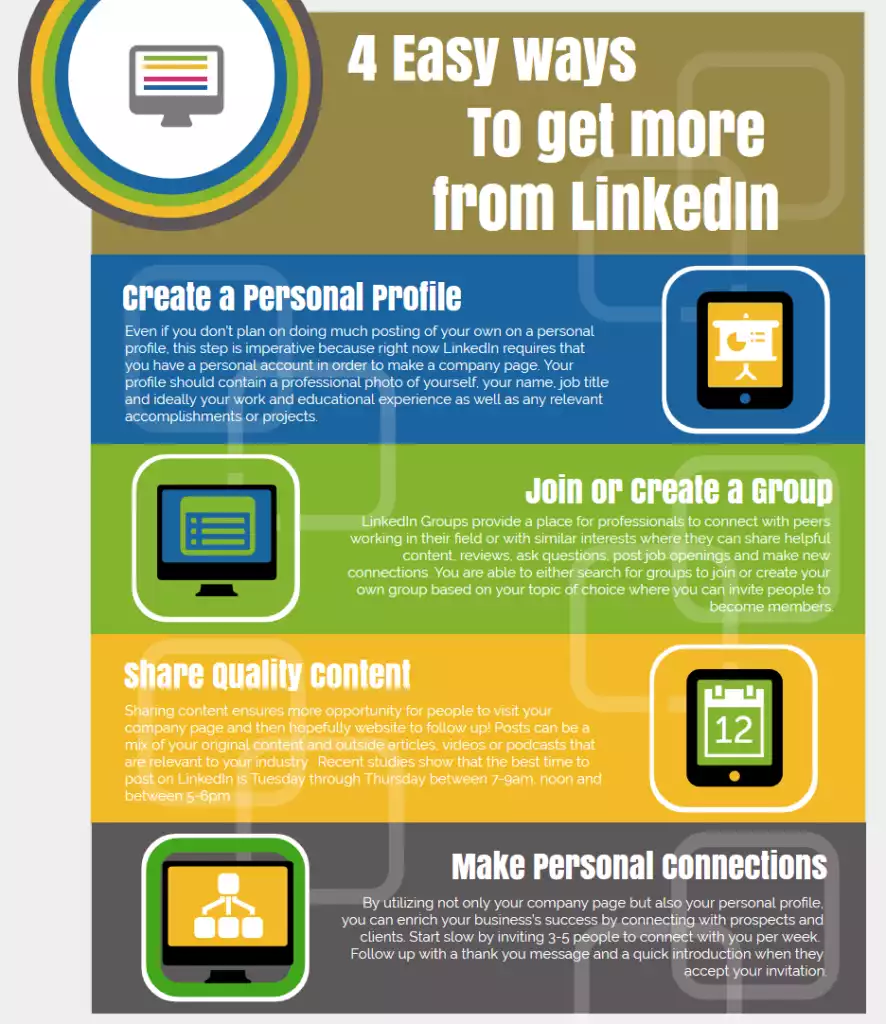
    As employee benefit agencies, we know it can be hard to figure out the best way to leverage social media for your company, so we’ve made it easy.  Follow these four steps to get more out of LinkedIn today!

    LinkedIn infographic


    Want to learn more? Go in depth with our post 5 Ways to Optimize LinkedIn for Your Benefit Agency.

  • 5 Ways to Optimize LinkedIn for Your Benefit Agency

    9011116378_32e56983e3_c
    Photo by Sebastiaan ter Burg

    LinkedIn is fast proving to be the foremost social media site for B2B marketing. Employee benefit agencies that rely on cultivating relationships in order to market a product or service may find utilizing more fast-moving social platforms like Twitter or Instagram challenging, but LinkedIn provides a space for professionals to interact with one another, share original industry content and create brand awareness for their company that results in leads and network growth. We’ve put together a list of five simple ways you can start optimizing LinkedIn for your business today:

    1. Create a Personal Profile

    Even if you don’t plan on doing much posting of your own on a personal profile, this step is imperative because right now LinkedIn requires that you have a personal account in order to make a company page. Your profile should contain a professional photo of yourself, your name, job title and ideally your work and educational experience as well as any relevant accomplishments or projects.

    1. Set Up a Company Page

    Now that you’ve created your personal page, you are able to set up a page that specifically provides information about your company to LinkedIn users.  This page should contain your company name, logo, a link to your website, and a short description of your business that includes relevant keywords that are specific to what you do. Keywords can be in the form of phrases such as “Maryland insurance broker” but should shy away from staying as vague as “insurance company.” This helps your page receive a higher ranking in search engine results. Finally, ask employees who have personal LinkedIn profiles to list your company in their work experience, helping ensure that you can be found easily when people search for your business.

    1. Share Quality Content

    Sharing content ensures more opportunity for people to visit your company page and then hopefully website to follow up! Posts can be a mix of your original content and outside articles, videos or podcasts that are relevant to your industry.  Recent studies show that the best time to post on LinkedIn is Tuesday through Thursday between 7-9am, noon and between 5-6pm.  In addition, data revealed that posts made on Tuesday between 10-11am have the most clicks and shares. For best engagement results, companies should make it a priority to post on their LinkedIn page once a week, but no more than once a day.

    1. Join or Create a Group

    LinkedIn Groups provide a place for professionals to connect with peers working in their field or with similar interests where they can share helpful content, reviews, ask questions, post job openings and make new connections. You are able to either search for groups to join or create your own group based on your topic of choice where you can invite people to become members.  These groups are useful for connecting with prospects and establishing your company as an industry expert.

    1. Make Personal Connections

    By utilizing not only your company page but also your personal profile, you can enrich your business’s success by connecting with prospects and clients. Start slow by inviting 3-5 people to connect with you per week.  Follow up with a thank you message and a quick introduction when they accept your invitation.  Did you write a blog for your company or on an industry topic?  Post it to you profile. As you continue to share content, consider submitting it to LinkedIn Pulse’s editors to have your blog post featured.  This translates to much more visibility for your company! Finally, don’t be afraid to engage with others.  If you see content you like, write a comment or send a quick message to the author.  Other LinkedIn members are interested in the same thing you are – building mutually beneficial relationships!

    Generating brand awareness for your company on social media is becoming more and more important in our highly digitalized economy. LinkedIn offers the perfect space for your company using a B2B marketing model that is based largely on relationships to thrive and establish yourself as an industry expert while expanding your network of prospects and future business connections.

  • 4 Reasons Why Blogging is Important for your Business

    There is some debate out there as to whether blogging is still relevant in today’s social media marketing environment.

    Regardless if you are a small business, or a multinational company, blogging is integral to your online content marketing strategy.

    Here are 4 reasons you need to blog:

    1.  Drive traffic to your website

    2.  Increase your SEO/ SERP

    3.  Position your brand as an industry leader

    4.  Develop better customer relationships

    Drive traffic to your website:

    Your blog gives you the opportunity to create relevant content for your customers. Use this as a marketing tactic to drive traffic back to your website.

    Make the blog on your website the foundation for all of your social media platforms.

    Your business might be on Facebook, Twitter, Pinterest, LinkedIn, or anywhere else. Post links  – with relevant visuals – of your blog articles to your social sites. Give your social followers a reason to click through to your website.

    Additionally, post inbound links directly in your blog articles, to drive traffic to specific landing pages of your website.

    Increase your SEO/ SERP:

    Blogs increase your SEO. Fresh content is still a key to beating out your competitors in the search engine results page.

    Use keywords in your articles. List out the keywords, topics, and categories you want your business to be found with. Use these words, and related expressions when writing your posts.

    Of course, whether you actively seek these out or not, blogging regularly about your business, industry, product or customer lifestyle will naturally increase your search keywords. Being intent about your words will only increase results.

    Keywords and topics on your website are a significant way in which Google (and other search engines) find your site for these searched words.

    Position your brand as an industry leader:

    Well written articles demonstrate your company as an industry leader. By posting topics which resonate with your market and show your knowledge, you are marketing your skills for your business, service or product too.

    If you are a retailer, for example, write blog posts about your products. Your customers will get to know you as the knowledge source for the products they want.

    If you are in B2B, post articulate, well researched articles about your service. Become the hub, or the place to be, for your industry.

    You are building trust, too. The more you can show that you are well-versed in your field, the more likely your consumer will trust you to supply what they need.

    Your customers additionally benefit from the learning you provide them.

    Develop better customer relationships:

    Blogs provide another source to deepen the connection with your customer. By connecting directly on your website, your clients are able to get to know your business or product from the comfort of your online home base.

    Use this. Again, build trust by being a source of information. Consumers like to be informed, and appreciate that you are the one teaching them.

    Additionally, just as on your other social sites, respond to comments and interact with your consumer. If they have questions about a product you are writing about, respond to them directly on your website. Unlike many social sites, a blog is generally searchable on your site for some time. Your website comments last longer than on a Twitter response or Facebook post. Other customers will see your interactions too.

    Source: Wishpond
    Written by: Krista Bunskoek, PR and Content Marketer @ Wishpond


  • Tips for an Awesome and SEO-Friendly Blog Post

    Writing a blog post -like all other writing- is a skill. In order to keep your reader interested, you should think about structuring your text and writing in an appealing style. You should help your readers to grasp the main idea of your post by providing headings, subheadings and clear paragraphs. If people understand and like your text, they are much more likely to share, like, tweet and link to your post. And that will increase your rankings! So, in order to improve your ranking in Google, you should definitely try to maximize your writing skills!

    For some, writing for SEO purposes and writing to attract and keep attracting your audience could appear as two contradictory goals. However, I totally disagree. Indeed, if you not only want a good but also an SEO-friendly blog post, your text should be written in such a way that the words you want to be found for have a very prominent place. And, using your keywords too often severely damages the readability of your text. So, you definitely should not do that!

    In this post, I would like to give some tips on writing blog posts that are both very readable as well as SEO-friendly. I genuinely think those two goals should (and can easily!) go hand in hand!

    Elementary writing tips for good blog posts

    Before anything, your blog post just has to be a good piece of writing! A lot of bloggers just begin to write after creating a new blog post. They just type what comes to mind. For some, this may be sufficient, because they are natural writing talents. Others may need some help. I always follow the next set of ‘rules’ myself.

    1. Think before you write!

    Think hard about the message of your text. What do you want to tell your readers? And what is the purpose of your text? What do you want you readers to do at the end of the page? Write down the answers to these questions before you begin writing.

    2. Write down the structure of your blog post.

    Every post should have some sort of introduction (in which you introduce your topic), a body (in which the main message is written) and a conclusion (which should summarize the most important ideas or deduce some new idea). Write down what you want to write in all these three sections. You now have some sort of summary of your post. The real writing can begin!

    3. Use paragraphs.

    Everybody uses paragraphs, but make sure to use paragraphs that make sense. Do not start a new sentence on a new line, just because it looks nice. There should be a reason for making a new paragraph. Every paragraph should have a main idea or a main subject. Ask yourself what the main idea of each paragraph is. You should be able to grasp that main idea in only one sentence. If you need more sentences, you simply need more paragraphs!

    4. Use Headings.

    If you want people to find their way in your articles, you should use subheadings. Subheadings will lead people, help them scan your page, and make the structure of your articles that much clearer.

    5. Use signal words.

    Signal words help people to scan through your text and help people to grasp your main idea. If you, for instance, have three reasons for wanting to sell a product, you should use signal words as: First of all, Secondly and Finally. Also, words as Nevertheless, Surely and Indeed also give a clear signal to your readers. Readers will instantly get that a conclusion will follow after words as Thus, So or Therefore. Signal words are thus very important to structure your text.

    6. Let other people read your post.

    Before publishing your post, let someone else read your post first. Ask him/her whether or not he understands the main idea of your post. Correct typo’s and sentences that are not formulated correctly.

  • 5 Benefits of Blogging for Your Small Business

    If you run a small business, chances are you are wondering if blogging is worth the time and effort. The short answer is a resounding YES! Blogging on a frequent basis is a relatively easy, inexpensive way to enhance your inbound marketing efforts, drive traffic to your site, and attract more perspective customers.

    The Case for Small Business Blogs

    Here are some of the most important benefits of having a blog for your business:

    1. Boost Search Engine Optimization-Search engines love fresh content. What better way to provide frequent content than with blog posts. By blogging consistently, you give Google and other search engines new content to index and you create opportunities to plug in those all-important keywords to increase your visibility on search engine results pages (SERPS).
    2. Develop Relationships with Potential and Existing Customers-Blogging allows you to connect with your site visitors. This can be accomplished by asking your readers questions at the end of your posts to get the conversation going or by simply allowing comments and feedback. By reviewing and responding to readers’ comments, you can create a rapport with your audience, build trust, and gain valuable insight into what your customers are looking for.
    3. Establish Your Business as an Industry Leader-No matter how small your business is, you can build trust and clout within your industry by providing valuable, expert information in your blog posts. Over time, you become a “go to” resource for helpful, informative content, which can ultimately lead to higher customer conversion rates. This is especially important for small businesses looking to gain credibility to compete with larger companies.
    4. Connect People to Your Brand-Blog posting allows you to show a personal side of your business that perspective and current customers won’t see through outbound marketing techniques. Blogging gives others a sense of the corporate standards, vision, and personality of your company.
    5. Create Opportunities for Sharing-Every time you blog, you create an opportunity for your audience to share your blog with others. Whether they link to your blog post, tweet it, or email it to others, it’s free marketing and it further validates you as a credible business.

    From a practical standpoint, blogging just makes sense. With minimal effort and expense, you can build credibility, boost search engine rankings, increase website traffic, and foster relationships with potential and current customers. This is an opportunity no small business should pass up.

    Read More – By Kelly Thomas Mango

    We are here to help with your blogging needs!  Rockstar Technology can drive traffic to your site with a new blog that can be integrated with all your social media outlets!